How to Use an Anion Gap Calculator to Tell Apart Acidosis Types
What the Anion Gap Shows
The anion gap is a practical way to assess acid-base balance and identify the likely cause of metabolic acidosis. It estimates the difference between measured positively charged and negatively charged particles in the blood, using values from a serum chemistry panel. In clinical interpretation, the anion gap is most useful as a diagnostic clue that assists classify acidosis types into high-gap and normal-gap patterns.
In simple terms, the gap reflects unmeasured anions in the bloodstream. When acids accumulate, or when bicarbonate is lost and replaced by chloride, the pattern of serum sodium, serum chloride, and serum bicarbonate changes in a distinct way. That makes the anion gap a quick screen for electrolyte imbalance and broader acid-base disorder evaluation.
The most common starting point is the basic chemistry panel. A clinician reviews sodium, chloride, and bicarbonate, then uses the result to guide the next step in the metabolic workup. This is where an anion gap calculator can be especially helpful: it speeds up the calculation, reduces arithmetic mistakes, and supports more rapid clinical interpretation at the bedside or in review of lab results.
The anion gap does not identify every cause by itself, but it gives a strong framework for differential diagnosis. A high gap suggests extra acids or retained acids. A normal gap suggests bicarbonate loss with compensatory chloride increase. That distinction is central to choosing the right follow-up tests and understanding the underlying physiology.
How to Determine the Anion Gap
The standard anion gap formula is:
Anion gap = serum sodium − (serum chloride + serum bicarbonate)
This formula uses serum sodium, serum chloride, and serum bicarbonate from standard labs. Because bicarbonate is a major buffer, the result gives insight into the body’s buffering capacity and whether acids are being accumulating or bicarbonate is being depleted. A reduced bicarbonate level usually goes along with metabolic acidosis, but the anion gap tells you whether that drop is being driven by extra acids or by chloride retention.
An anion gap calculator can calculate anion gap immediately from input lab values and may also show a corrected anion gap when albumin is included. This matters because albumin correction can reveal masked high-gap acidosis that might otherwise appear more normal. Albumin is a negatively charged protein, so low albumin reduces the measured gap and can mask the presence of unmeasured acids.
For that reason, the raw number should never be read alone. Always compare it with the local reference range and consider the patient’s albumin level. A normal-looking gap may still be abnormal after correction, especially if hypoalbuminemia is presented.
Practical steps to calculate anion gap:
- Confirm the values from the serum chemistry panel.
- Use serum sodium, serum chloride, and serum bicarbonate.
- Enter them into an anion gap calculator or apply the anion gap formula manually.
- Check whether albumin correction is needed.
- Compare the result with the local reference range and the clinical picture.
In many cases, the result becomes the first major decision point: high anion gap metabolic acidosis or normal anion gap metabolic acidosis.
Elevated Anion Gap Metabolic Acidosis
High anion gap metabolic acidosis occurs when acids accumulate and introduce unmeasured anions to the blood. The gap widens because bicarbonate is used up buffering excess acid, but chloride does not rise enough to replace it. This pattern often indicates serious illness and requires prompt recognition.
Common causes include lactic acidosis, ketoacidosis, and renal failure. Each has a different mechanism, but all can cause a high-gap pattern:
- Lactic acidosis: Excess lactate builds up when tissues are not well perfused or metabolism is disrupted.
- Ketoacidosis: Excess ketones build up, often in diabetes, starvation, or alcohol-related states.
- Renal failure: The kidneys cannot excrete acids efficiently, so unmeasured anions increase.
From a clinical standpoint, the anion gap helps guide urgency. A patient with high-gap acidosis may need immediate assessment of perfusion, glucose, kidney function, and possible infection or ischemia. The gap is not the diagnosis itself, but it is a strong marker that something is adding acid rather than simply replacing bicarbonate with chloride.
High-gap acidosis is also where the broader acid-base pattern matters. If the bicarbonate is very low and the pH is severely reduced, the body may show a strong compensatory response through hyperventilation. That response supports respiratory compensation, but it does not fix the underlying problem. The calculator result should prompt the clinician to search for the source of acid production or impaired acid clearance.
Normal Anion Gap Metabolic Acidosis
Normal anion gap metabolic acidosis is commonly known as chloride-rich acidosis because chloride rises as bicarbonate falls, leaving the gap relatively stable. In this pattern, the body loses bicarbonate or gains a chloride-rich load, but there is not a large buildup of unmeasured anions. The result is still metabolic acidosis, just with a different biochemical signature.
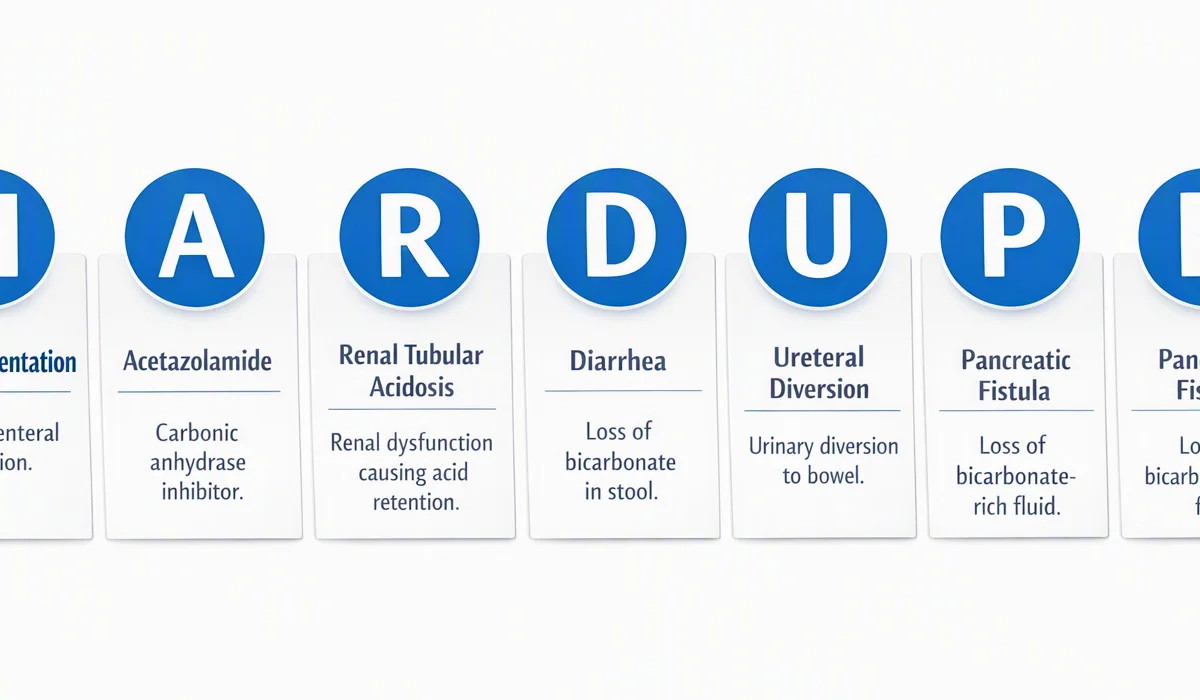
Two classic causes are diarrhea and tubular renal acidosis. In diarrhea, bicarbonate is lost from the gastrointestinal tract. In tubular renal acidosis, the kidneys cannot properly handle acid secretion or bicarbonate reabsorption. Both lead to low serum bicarbonate and a compensatory increase in chloride, which is why the term hyperchloremic acidosis is so useful.
Other normal-gap causes can include certain medications, renal salt-handling problems, and fluid-related chloride loads. The key point is that the gap does not rise significantly because the missing bicarbonate is replaced by chloride rather than by unmeasured acids. That makes the anion gap a strong diagnostic aid for the list of possible causes.
When interpreting this pattern, ask whether the acid-base problem reflects a true loss of bicarbonate or a kidney problem that prevents the body from correcting the imbalance. A normal gap does not mean the acid-base status is mild; it simply means the mechanism is different from high-gap acidosis.
Applying the Anion Gap to Narrow the Differential
The main advantage of the anion gap comes from how it focuses the acid-base disorder after you identify metabolic acidosis. After the calculator shows the gap, the result guides the next branch of reasoning:
- When the gap is high, think about additional acids, toxin exposure, poor perfusion, or reduced renal clearance.
- When the gap is normal, think about bicarbonate loss or chloride gain.
One useful step is the delta gap, which contrasts the rise in the anion gap with the fall in bicarbonate. This can reveal mixed disorders. For example, a very high gap with less bicarbonate drop than expected may suggest an additional metabolic alkalosis. Conversely, a disproportionate bicarbonate fall may suggest a second process lowering bicarbonate beyond the primary high-gap problem.
Respiratory compensation should also be considered. In metabolic acidosis, the lungs often lower carbon dioxide through faster breathing. If the expected compensation is absent or excessive, there may be an added respiratory problem. That is why the anion gap is best used alongside pH and carbon dioxide data rather than alone.
In practice, the flow is straightforward: determine the gap, identify the acidosis, assess the compensation, then look for the cause. This sequence enhances clinical interpretation and minimizes the chance of missing a mixed disorder or overlooking a second diagnosis.
Frequent Calculation Errors
Even a proper formula can misguide if the values or setting are wrong. One of the most typical issues is forgetting to apply albumin correction. As albumin is a important unmeasured anion, a low albumin level can cause the gap appear incorrectly normal. Such a result can hide a clinically important high-gap process.
Another common pitfall is overlooking the local laboratory reference range. Different labs use somewhat different methods and intervals, so a borderline result may be interpreted differently depending on the setting. Be sure to compare the number with the appropriate range rather than depending on a universal cutoff.
Measurement error can also influence the result. Small inaccuracies in sodium, chloride, or bicarbonate may produce an apparently abnormal gap, especially when the real difference is limited. Repeating the test or reviewing the specimen quality may be necessary if the result does not fit the clinical picture.
Also remember the osmolar gap. While it is a different calculation, it can be very relevant when the clinical scenario suggests toxic alcohol or other unmeasured solutes. A normal anion gap does not rule out a toxic ingestion, and a high anion gap does not prove one. The two gaps can inform each other in the diagnostic workup.
Further cautions:
- Avoid interpret the gap without reviewing albumin.
- Avoid assume a normal result rules out serious illness.
- Do not forget that treatment fluids can influence chloride and bicarbonate.
- Do not overread a single borderline value without trend data.
When the Anion Gap Is Not Enough
The anion gap is a strong tool, but it is merely part of the assessment. If the cause of acidosis is not obvious, an arterial blood gas can provide essential contextual detail. Blood gas analysis shows pH, carbon dioxide, and bicarbonate trends that help confirm the presence and severity of the acid-base disorder.
A lactate level is often the next step when high-gap acidosis is suspected, especially if lactic acidosis is possible. Elevated lactate can suggest tissue hypoperfusion, sepsis, seizures, or other stress states. Likewise, glucose and ketone testing are necessary if ketoacidosis is in the differential.
Toxin ingestion must also be considered when the presentation is unexplained or severe. Certain ingestions can cause high-gap acidosis, and some may also affect the osmolar gap. If the history, exam, or lab pattern suggests exposure, the anion gap should prompt a broader toxicology-oriented evaluation rather than being treated as the final answer.
In short, the anion gap shows where to focus, but not always what you will find. It is most useful when integrated with blood gas data, lactate, renal testing, glucose, ketones, and the clinical story. That combined approach leads to a more accurate GOLD MARK toxic causes differential diagnosis and safer decision-making.
FAQ About Anion Gap and Acidosis
What does a high anion gap mean in acidosis?
A high anion gap usually means there are extra unmeasured anions in the blood, which points to high anion gap metabolic acidosis. Common causes include lactic acidosis, ketoacidosis, renal failure, and some cases of toxin ingestion. It is a strong diagnostic clue that the body is accumulating acid rather than just losing bicarbonate.
How do you calculate the anion gap from lab values?
Use the anion gap formula: serum sodium minus the sum of serum chloride and serum bicarbonate. An anion gap calculator automates this step and can help you quickly calculate anion gap values from the serum chemistry panel. If albumin is low, apply albumin correction for a more accurate corrected anion gap.
What causes normal anion gap metabolic acidosis?
Metabolic acidosis with a normal anion gap is usually due to bicarbonate loss or chloride gain. Typical examples include diarrhea, renal tubular acidosis, and other forms of hyperchloremic acidosis. It stays normal because chloride rises as bicarbonate falls.
Why is it important to correct the anion gap for albumin?
Albumin correction is needed because albumin is a major unmeasured anion. When albumin is low, the measured anion gap can appear falsely normal, which may hide high anion gap metabolic acidosis. Correcting for albumin improves clinical interpretation and helps reveal the true acid-base pattern.
When is it appropriate to order additional tests after checking the anion gap?
Order additional tests when the result suggests a serious disorder, the cause is unclear, or the clinical picture does not match the number. Typical follow-up tests include an arterial blood gas, blood gas analysis, lactate level, ketones, kidney testing, and evaluation for toxin ingestion. If the gap is borderline or confusing, consider the osmolar gap and review for measurement error or the need for albumin correction.